

How Neuroscience is Redefining the B2B Sales Playbook
In boardrooms around the world, we like to believe that decisions are made by logic, driven by data, and filtered through spreadsheets. Yet, neuroscience continues to prove otherwise: Even the most rational buyers make emotional decisions first and use logic to justify them later.
If you’re in sales, especially in complex B2B environments, this isn’t just a psychological curiosity, it’s a strategic insight you can’t afford to ignore.
🤯 The Neuroscience Behind B2B Buying Behavior
Antonio Damasio, a renowned neuroscientist, once said:
“We are not thinking machines that feel. We are feeling machines that think.”
In his studies of patients with damaged emotional centers in the brain, Damasio observed that although they could process information logically, they couldn’t make even the simplest decisions like choosing what to eat. The conclusion? Emotions are essential to decision-making.
This holds especially true in sales.
B2B buyers may justify decisions with ROI, payback period, or technical superiority. But they decide based on how confident, safe, validated, or excited they feel about the vendor. Emotions like trust, fear of missing out, personal reputation, and risk aversion play critical roles.
Real-World Evidence: B2B Isn’t as Rational as We Think
- A Google-CEB study (now Gartner) found that B2B buyers are more emotionally connected to the brands they buy from than B2C consumers.
In fact, 50% of B2B buyers are more likely to buy when they see personal value in a B2B offering.
- A Harvard Business Review article reported that executives are five times more likely to consider a brand if they feel a personal connection.
- Consider this real example: When Salesforce introduced its cloud-based CRM, it wasn’t just selling features. It positioned itself as a movement empowering salespeople, freeing IT departments, and inspiring innovation. Their “No Software” logo wasn’t rational, it was emotional. And it worked.
The Emotional Drivers You Can’t Ignore in B2B Sales
Here are 4 powerful emotional triggers that impact B2B decisions:
- Trust & Safety: Buyers want to feel safe with you. Not just with your product, but with your people, process, and partnership.
- Fear of Regret: “What if this fails?” “What if I lose face internally?” “What will this cost me personally?” These silent fears can derail deals more than budget constraints.
- Hope for Gain: Will this solution make me look good? Can I show tangible wins to my boss? Will it elevate my status or visibility?
- Shared Values: Buyers increasingly care if your brand stands for something. Sustainability, innovation, empathy—they want to know who they’re partnering with.
A Simple Framework: The E.A.S.E. Model
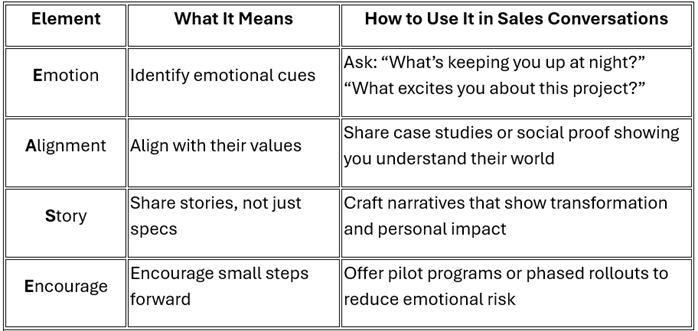
To help sales professionals navigate emotional decision-making in B2B sales, I’ve developed the E.A.S.E. Framework:
When you E.A.S.E. into emotional decision-making, you lower the buyer’s resistance and boost engagement.
Case in Point: The Procurement Paradox
Let’s take the example of a large Middle East-based logistics provider. The procurement head, a seasoned executive with two decades in the industry, had strict ROI metrics. On paper, Vendor A offered the best price and features.
But they chose Vendor B.
Why?
Because Vendor B’s sales team understood the emotional cost of failure. They framed their solution not just as a software upgrade, but as a career-protecting partnership. They acknowledged the risks, shared success stories from similar companies, and gave the procurement head the peace of mind that “you won’t be alone after the sale.”
Thought-Provoking Questions to Ask Yourself
- Are you selling to the company or to the career aspirations of your buyer?
- Do your sales presentations focus only on logic, or do they also inspire confidence and belief?
- Are you recognizing the buyer’s personal fears—not just professional objections?
- What emotional tone does your messaging convey—safety, excitement, urgency, or reassurance?
Start asking these questions in your next strategy meeting. The answers might reveal why your deals are stuck in “maybe” land.
Balancing Logic and Emotion: It’s Not Either/Or
This isn’t to say that ROI, total cost of ownership, or implementation timelines don’t matter. They do. But they matter after the emotional buy-in.
Great sales professionals know how to trigger emotion early, then back it up with logic.
You’re not selling a product. You’re helping someone make a safe decision in a complex world. When they believe you understand them, they’ll be more inclined to believe in your solution.
From Neurosales to Normal Sales: A Shift in Perspective
The most effective B2B sellers are blending cognitive neuroscience with practical sales techniques. They’re not manipulating emotions, they’re understanding and respecting them.
The future of sales isn’t about being more persuasive. It’s about being more perceptive.
In My View
Too many sales teams still sell as if they’re presenting to robots. But buyers aren’t spreadsheets, they’re people. And people carry emotions, ambitions, and anxieties into every boardroom decision. If we want to truly connect, influence, and close, we must meet our buyers where they are, emotionally first, logically second. And when we do, we stop pitching and start partnering.
So the next time you walk into a sales meeting, don’t just ask: “What does this company need?” Also ask: “What does this person feel?”
That’s where the real sale begins.